The Bridge, Santa Marta
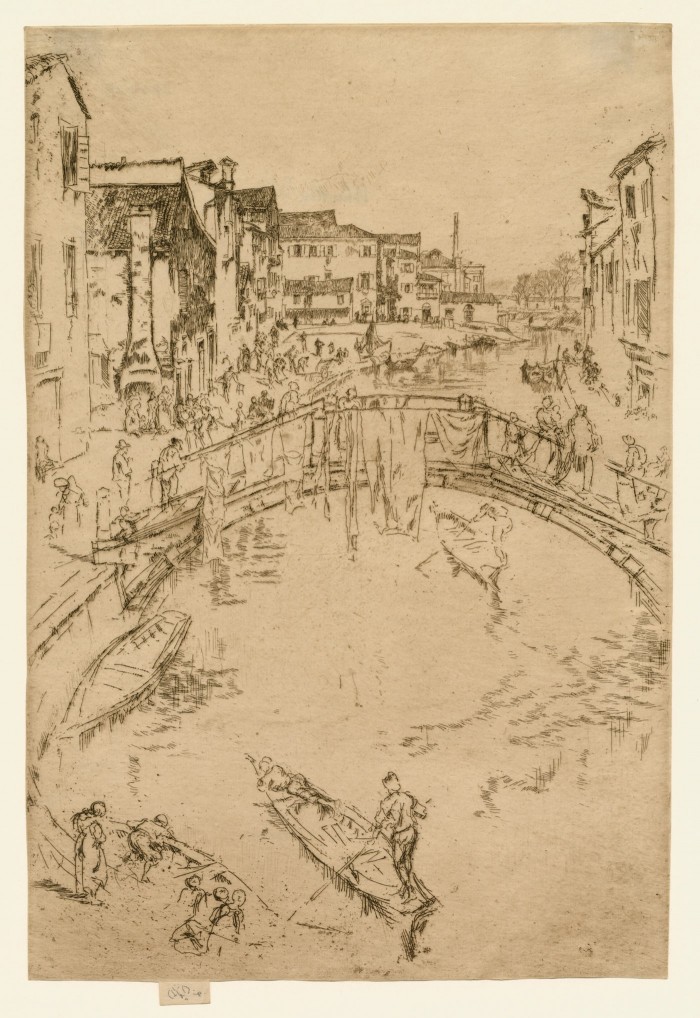
James Whistler (1834-1903), The Bridge, Santa Marta, 1879-80, etching with drypoint, printed in sepia on fine laid paper. Signed with the butterfly and inscribed imp on the tab (also with an exceedingly light butterfly lower right in the plate). Kennedy 204, probably eighth (final) state; Glasgow 201, probably state 9 (of 9) (cf. Margaret F. MacDonald, Grischka Petri, Meg Hausberg, and Joanna Meacock, James McNeill Whistler: The Etchings, a catalogue raisonné, University of Glasgow, 2011), Lochnan 199. Trimmed to the platemark by the artist, h: 11.8 x w: 7.9 in / h: 30 x w: 20.1 cm.
A fine impression, printed with subtle tone.
The bridge theme occurs repeatedly in Whistler’s vistas. It is also the main focus of more than one of the Venetian prints. While some bridges are seen from below, from where one would see it if approaching in a gondola (for example Ponte del Piovan, Kennedy 209), The Bridge depicts the scene from a high perspective, opening up the view into the far distance. The small boat approaching the arch in the foreground is again, as in the earlier Thames prints, a stock motif that is probably ultimately derived from the Japanese woodcuts of Hokusai and Hiroshige. The bridge here is the Ponte de le Terese over the Rio de l’Arzere in the Santa Marta quarter.
The early biography of Whistler by Elizabeth and Joseph Pennell is essential for its “immense quantity of information” but also notorious for “the inherent hyperbole and misinformation” (Eric Denker, Annotated Bibliography, in Fine, p. 184). Still, it is worth quoting from the Pennels’ appraisal of The Bridge: “Simplicity of expression has never been carried further. Probably the finest plate, in its simplicity and directness, is The Bridge. Whistler now obtained the quality of richness by suggesting detail, and also by printing. In The Traghetto there is the same scheme as in The Miser and The Kitchen, but the Venice plate is more painterlike. Without taking away from the etched line he has given a fullness of tone which makes the background of [Rembrandt’s ] The Burgomaster Six weak by comparison. And he knew this” (Pennell/Pennell, p. 197).
The plate was originally advertised for but not included in the First Venice Set where it was substituted by the somewhat more conventional view of The Little Mast (Kennedy 185). It was published as part of the Second Venice Set in 1886.