The Mill
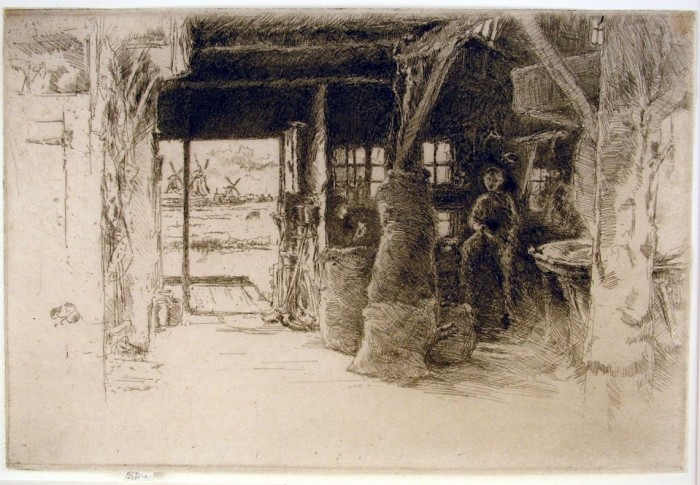
James Whistler (1834-1903), The Mill, 1889, etching and drypoint, signed in pencil with the butterfly on the tab and inscribed “imp”, and inscribed “first state” (twice) and annotated “Wunderlich” and signed again with the butterfly verso. Reference: Kennedy 413, first state (of 5). Glasgow 457, second state (of 6; see discussion below) (cf. Margaret F. MacDonald, Grischka Petri, Meg Hausberg, and Joanna Meacock, James McNeill Whistler: The Etchings, a catalogue raisonné, University of Glasgow, 2011)
On laid paper, in very good condition, trimmed just outside of the platemark all around except for the tab by the artist, 6 1/4 x 9 3/8 inches.
A very fine impression of this great rarity, printed in black/brown ink with a slight veil of plate tone.
provenance:
H. Wunderlich & Co., New York
Louis B. Dailey, New York (Lugt 4500)
sale, Sotheby’s, New York, October 31, 2003, lot 69
literature;
Neue Lagerliste 122: James McNeill Whistler – Etchings and Lithographs, sale catalogue, C.G. Boerner/Harris Schrank Fine Prints, New York/Düsseldorf 2007, no. 39
A very fine impression.
This impression shows accents of fresh drypoint work with burr, most discernable above the head of the woman standing in the shadows at right, above her right hand, and close to her left foot; these touches and additional lines on the woman seated at the left suggest this is a second state, not a first as noted by the artist (and, according to Glasgow, the only example of this state). It is a much richer impression, with more drypoint burr, than the examples of the first state (at the National Gallery and the Freer, Washington D.C.)
The print is annotated by Whistler himself in pencil on the verso 1st state (twice) and signed again with a small butterfly. Below this, the artist wrote Wunderlich, designating this impression for Hermann Wunderlich, the founder of H. Wunderlich & Co. in New York and the artist’s first and most important dealer in the United States. Whistler is known to have chosen particularly fine impressions for Wunderlich.
The print is extremely rare in every state. Fine calls it “little known because of its rarity” (p. 179) and Glasgow lists no more than a total of 13 impression. To our knowledge this is the only impression to have reached the market in the past thirty years.
Whistler attempted in his Amsterdam etchings to use extensive etching and drypoint lines to create the atmospheric changes in tone which he achieved in the Venice group through plate tone. Doing so, he created extremely delicate plates, which could only produce a few impressions before the plate became unusable.
Critics have viewed The Mill as a paean to Rembrandt, which it surely is, but one wonders whether Whistler might have also thought of the etchings of Van Ostade, particularly those showing the shadowy indoor settings (such as The Barn), with workers or peasants merging into the darkness. Whistler’s brilliant chiaroscuro etchings (such as Doorway and Vine, or the Nocturne: Furnace of the Venice Set) come to mind also – here the light of day illuminates windmills in the horizon.
POR